

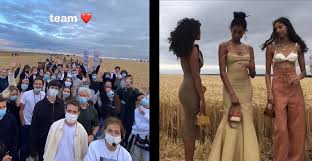
For years, the fashion industry has been scrutinised for their lack of diversity and inclusion, a problem that spans across every industry. Not enough representation of black, Asian and Latinx models in their ads, on their runways and throughout the pages of their magazines but this year more than any, the focus has been shifted to the teams behind the camera. With the importance of diversity on a rise, brands have come under fire for their “skin deep wokeness”. One Parisian fashion house, known for their beautifully progressive cast of models, was recently called out for their all-white team after a selfie was taken in celebration of their SS 21 show. An almost perfect depiction of performative activism, when the only part of your brand that is diverse is the part the public can see. A similar conversation sparked last May when Virgil Abloh, founder of Off-White, posted his team of art directors which happen to be 7 white men. Although the industries diversity isn’t under these 2 designers charge, it is an interesting look into the part that world us outsiders don’t see.
However, the fashion industry is not the only one guilty of this facade of change, Sharon Chuter, founder of makeup brand UOMA, used her platform recently to encourage beauty companies to share how many black people they have in their senior executive positions. Her research showed that 10% of every white-collar company should be black people to match the statistic of how many black people graduate college annually. Chuter revealed that currently, the average percentage of BIPOC (Black, Indigenous and people of colour) in an American white-collar workforce is 8% and only 3.2% in senior management positions. Her 72 hour “pull up or shut up” campaign called on brands that capitalise off the black community, in particular, to show their consumers how many black people are working behind the scenes. Hundreds of beauty brands did pull up; Kylie cosmetics revealed that 13% of their “all woman” team is black and some brands like L’Oréal USA acknowledged they have more to do to create a diverse workforce.
Challenging diversity optics like this is important in a world where looking like you’re doing something is enough to prove you care about a cause. Where multi-million dollar companies can post a black square on Instagram to show their “support” and have people praise them or where having 4 black models on the same stage as 20 white ones, is seen as “diverse”. It is hard enough being a black model breaking into a predominantly white field but the lack of diversity in the team means facing problems with makeup, hair and lighting. Inclusivity is having a makeup artist who won’t make a black woman look grey, a hairstylist who can work on 4b hair and a set stylist whos lighting won’t wash out someone darker than MACs NC15.
It might seem confusing as to why performative activism is problematic, you might ask “why does it matter, isn’t it still activism?” or “isn’t diversity in any sense still good?”. To an extent, yes. When a BIPOC can flip through a magazine and see multiple models who look like them, it is a good thing but when they cant see themselves in a picture of the team who put it together, its simply no longer a good thing. Black people, just like every other person who worked hard to get where they are, deserve to be seen in every area of the industry, the parts the public see and the parts backstage. When black people are used merely as props in the name of wokeness or for the aesthetic it is not progressive as it looks, it is acting for social capital.
Classism has proved to be just as problematic and stands as one of the barriers stopping BIPOC breaking into the industry. Fashion capitals London, Paris and Milan remain the best places to get started but also hold the title for the most extortionate costs of living and without a degree, connections and experience its no surprise the majority are from middle-class families that paid their way through unpaid internships.
In the wake of ongoing Black Lives Matter protests, there hasn’t been a better time to tackle performative activism and make up for the decades of structurally exclusive industries that reject BIPOC behind the scenes. Let’s start making real change. Let us not fail another generation.
 What Caitlin Says
Leave a comment